Kaiser Permanente Revenue Cycle Automation: RPA Press Release, Case Study & Partnership Analysis – Best 2026 Guide
In 2026, Kaiser Permanente revenue cycle automation stands out as one of the best examples of how big healthcare organizations use RPA and automation to fix their revenue cycle. Let’s explore exactly how they do it.
What is Kaiser Permanente?
Kaiser Permanente is the largest nonprofit integrated healthcare system in the United States. Founded in 1945 by industrialist Henry J. Kaiser and physician Sidney R. Garfield, the organization started by providing medical services at Kaiser’s shipyards and steel mills before opening to the general public.
Today, Kaiser Permanente operates as a unique consortium of three connected entities:
Kaiser Foundation Health Plan – This is the insurance arm of the organization.
Kaiser Foundation Hospitals – This is the facility that runs the hospitals and medical offices.
Permanente Medical Groups – This is the physician made up of doctors who care for patients.
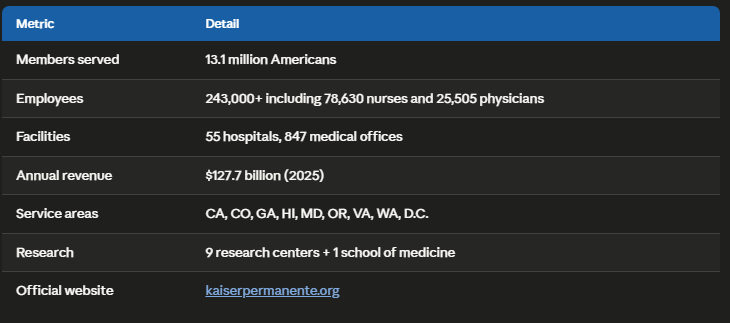
Official Website: kaiserpermanente.org or kp.org
Media Relations Contact : 626-405-5534 – Elita.T.Fielder@kp.org
General Inquiries : 1-888-406-2269 (TTY 711)

What is Revenue Cycle Automation?
Revenue cycle automation means using software robots and smart tools to handle the path a bill takes from start to finish. This includes checking insurance, sending claims, fixing denials, and getting payments posted.
For a giant health system like Kaiser Permanente, which handles billing for more than 13 million members, even small improvements in billing speed can mean millions of dollars in faster payments. That is why they have invested heavily in making their revenue cycle smarter.
What RPA tools does Kaiser Permanente use?
Kaiser Permanente uses a smart mix of RPA tools depending on the specific job. They do not put all their eggs in one basket. Here are the main platforms in use during 2026.
UiPath
This is Kaiser’s primary RPA platform for many automation projects. According to RPA professionals who have worked inside Kaiser, the UiPath platform supports over 100 bots and generates automation savings of more than $50 million annually. These bots are used across ITOPS infrastructure, claims processing, and data reporting.
Automation Anywhere
This tool is also deployed for specific workflows, particularly where large-scale data handling is needed. The organization uses multiple robotic tools across different phases of the software development lifecycle.
Workato
This is the integration platform that connects Kaiser’s various systems and applications. It helps data flow smoothly between different software environments.
Oracle Business Process Weaver
This is the tool used for billing automation specifically. Kaiser partnered with SpearMC Consulting to deploy this framework within the PeopleSoft ecosystem. It automates the sequence of billing tasks and eliminates manual intervention points.
Kaiser picks the right tool for each specific revenue cycle task rather than forcing one solution everywhere.
How Kaiser Permanente uses RPA in its revenue cycle
Here are the main ways Kaiser Permanente uses automation to get paid faster and reduce manual work.
1. Automated Billing for Contracts and Grants
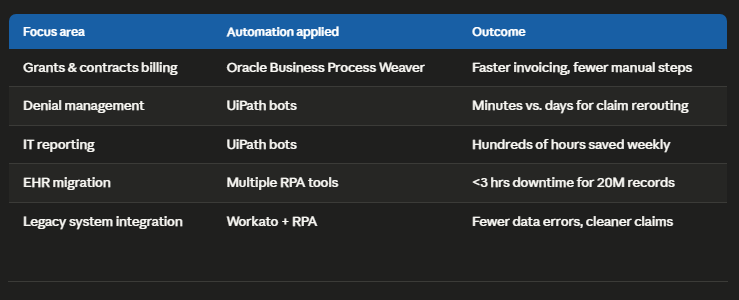
Before automation, billing staff manually hunted for billing interface numbers and triggered each billing process one by one. Not complicated, but slow, repetitive, and easy to miss. Oracle Business Process Weaver eliminated that. The system now triggers the billing interface automatically when the contracts-to-billing workflow runs.
2. Denial Management with RPA
When an insurer rejects a claim, something needs to happen fast or money sits in limbo. Kaiser’s RPA bots read denial reason codes, identify what’s missing, and route the claim back for correction, often within minutes. At Kaiser’s volume, faster denial resolution means meaningfully faster cash collection.
3. Connecting Old Systems with New Systems
Like most large health systems, Kaiser runs some older platforms that weren’t designed to communicate with newer software. RPA bots serve as connectors, logging into legacy systems, pulling the needed data, entering it into current systems automatically. This prevents the data entry errors that cause claim rejections.
4. ITOPS Automation and Reporting
Beyond billing, Kaiser uses RPA to automate IT operations tasks. Bots generate weekly and daily automated reports on server patching, configuration management, and vulnerability tracking for over 150 application IDs. This single automation saves hundreds of hours of manual downloading and formatting every week.
5. EHR Consolidation Support
In 2025, Kaiser completed one of the more ambitious EHR consolidation projects in U.S. healthcare history, reducing 12 separate EHR instances down to two. RPA bots handled repetitive migration tasks, transferred personalization settings for 18,000 physicians, and validated data integrity throughout. The result: less than three hours of planned downtime while moving 20 million patient records.
The Oracle & SpearMC case study
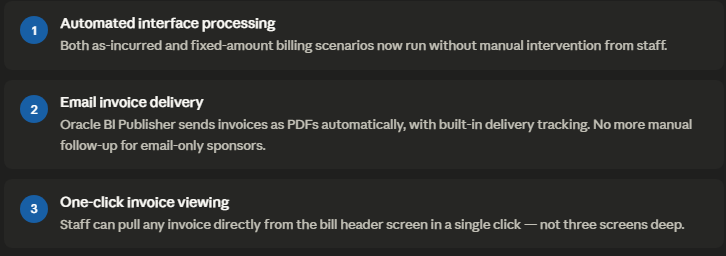
The most documented example of Kaiser’s automation work is the grants and contracts billing project from 2023. Kaiser partnered with SpearMC Consulting to deploy Oracle’s PeopleSoft Business Process Weaver. The official Oracle case study details the outcome.
The project delivered three major wins:
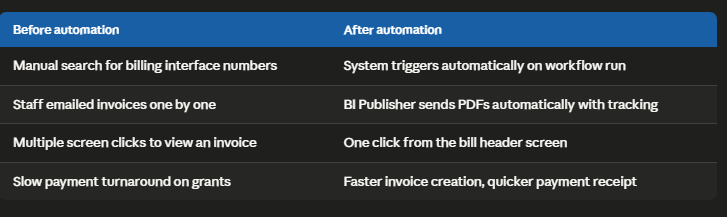
These look like small changes. But in a large organization where billing staff handle hundreds of contracts simultaneously, removing manual steps from each one compounds into serious time and money saved.
Kaiser Permanente’s digital strategy in 2026
RPA is one piece of a larger picture. A 2026 Stanford Graduate School of Business case study on Kaiser’s Care Transformation Office found that successful automation requires alignment between IT capabilities, clinical workflows, and organizational culture. Technology alone doesn’t fix broken processes.
In January 2026, Innovaccer and Hospitalogy named Kaiser among the top 15 U.S. health systems leading the shift toward AI-driven orchestration across clinical, operational, and financial functions. Their key finding: health systems that deploy automation without redesigning the work itself see limited gains. Kaiser has focused on both.
Key benefits Kaiser has seen from automation
Kaiser Permanente continues investing in RPA and automation in 2026 for several important reasons.
Faster Payments
Automated billing means invoices go out sooner and payments arrive faster. This improves cash flow across the entire organization.
Fewer Manual Errors
Robots follow rules exactly. They do not make typos or forget steps. This reduces costly claim rejections.
Staff Satisfaction
Billing staff get to stop doing boring copy-paste work and focus on solving complex problems that actually require human judgment.
Scalability
With over 100 bots running across the UiPath platform generating $50 million in annual savings, Kaiser has built automation capacity that grows with the organization.
How to start revenue cycle automation at your organization
Kaiser is a $127B system with a dedicated automation team. That’s not where most organizations start. But the approach is scalable.
Step 1 – Start with one small job.
Pick a boring, repetitive task like emailing invoices or checking claim statuses. That is a perfect first automation project.
Step 2 – Pick the right RPA tool.
UiPath is often a good starting point because it is easier to learn and has strong healthcare features. Kaiser uses it as their primary platform.
Step 3 – Find a good partner.
Kaiser worked with SpearMC Consulting to implement their Oracle automation. A knowledgeable partner can help you avoid mistakes.
Step 4 – Train your team.
Most RPA tools today use drag-and-drop builders. You do not need programmers to create helpful bots.
Step 5 – Measure your results.
Track time saved and faster payments. Use that success to build support for more automation projects.
Resources and outbound links
| Source | What you’ll find | Link |
|---|---|---|
| Kaiser Permanente | Official website and newsroom | kaiserpermanente.org |
| Kaiser Newsroom | Press releases and automation updates | about.kaiserpermanente.org |
| Oracle Case Study | Full billing automation documentation | oracle.com/healthcare |
| SpearMC Consulting | PeopleSoft implementation partner | spearmc.com |
| UiPath Healthcare | RPA use cases and tools for health systems | uipath.com/healthcare |
| Automation Anywhere | Healthcare automation success stories | automationanywhere.com |
| HFMA | Revenue cycle management fundamentals | hfma.org/revenue-cycle |
| CMS | Official healthcare billing guidance | cms.gov/medicare/billing |
| Innovaccer | 2026 Autonomous Healthcare report | innovaccer.com |
| Stanford GSB | Kaiser Care Transformation Office case | gsb.stanford.edu |
| Microsoft Power Automate | Entry-level RPA for smaller organizations | powerautomate.microsoft.com |
| Workato | Integration platform Kaiser uses | workato.com |
Final Thoughts on Kaiser Permanente RPA and Revenue Cycle Automation
Kaiser Permanente shows what’s possible when automation is taken seriously. By starting with targeted projects like automating contract billing with Oracle and SpearMC Consulting, they built an RPA platform with over 100 UiPath bots, saving $50 million annually.
Whether you run a small clinic or a multi‑state hospital system, revenue cycle automation helps you get paid faster, reduce errors, and free your team to focus on patients.
The best time to start was yesterday. The next best time is today, with Cureintent in 2026