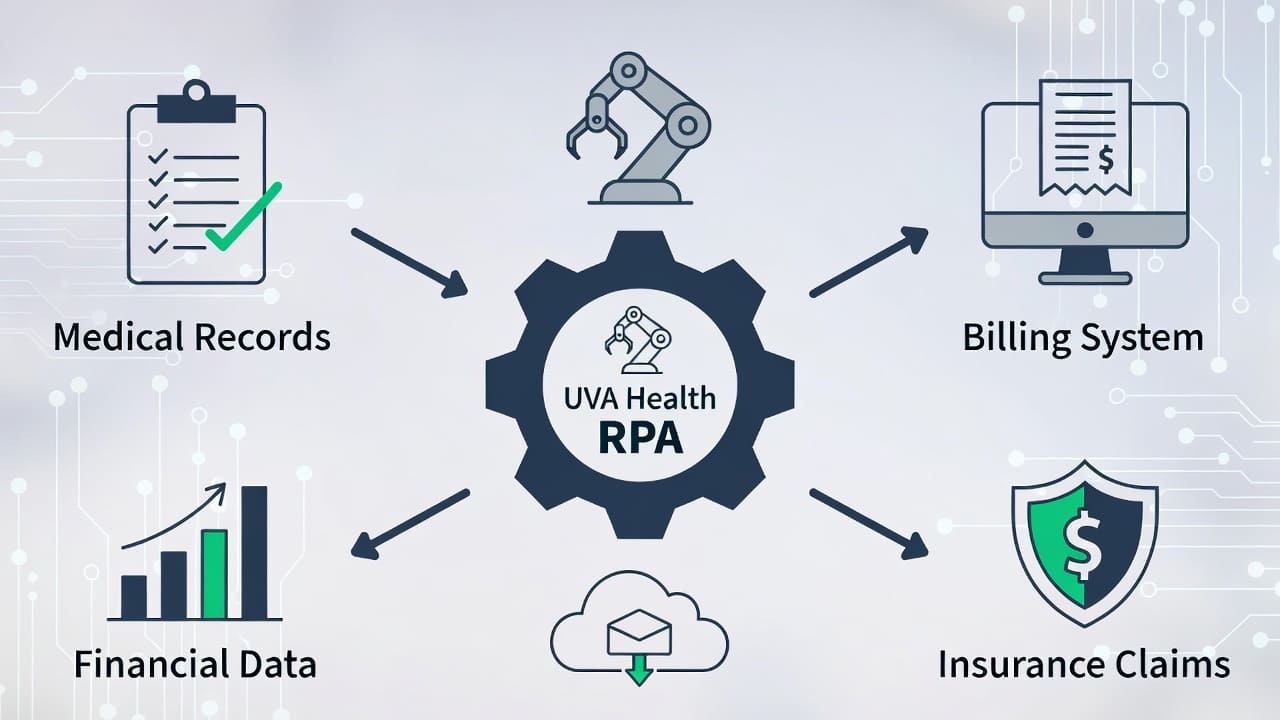
Before I dive into UVA Health’s story, let me show you what healthcare professionals are actually searching for when it comes to RPA in healthcare and medical billing automation. These keywords reveal what matters most right now in the UVA Health digital transformation journey.
Keyword
Monthly Searches
healthcare RPA
18,100
medical billing automation
18,100
RPA in healthcare
14,800
healthcare digital transformation
12,900
automated revenue cycle management
12,900
robotic process automation healthcare
8,100
claims processing automation
8,100
revenue cycle automation software
6,600
benefits of RPA in healthcare
5,400
RPA healthcare use cases
4,400
healthcare automation solutions
4,400
RPA for medical billing
3,600
hospital billing automation
3,600
RPA implementation roadmap healthcare
2,900
automated eligibility verification
2,400
RPA healthcare cost savings
2,200
EHR billing automation
2,200
RPA ROI healthcare
1,800
intelligent automation in healthcare
1,600
digital workflow transformation healthcare
1,400
The Challenge UVA Health Was Facing Before RPA
Let me walk you through what UVA Health’s billing department looked like before their digital transformation healthcare trends initiative. Like many large health systems, they were drowning in manual work.
Before Automation:
Process
How It Was Done
The Problem
Payment posting
Staff manually typed every payment
2,500+ payments daily = 3-5 day backlog
Insurance verification
Staff called or logged into insurance sites
15-20 minutes per patient = 40% of staff time
Claim status checks
Staff visited 30+ different payer portals
20 hours every week just checking status
Denial management
Staff researched and appealed manually
65% of denials never got appealed
Let me give you a concrete example. When a patient arrived for an appointment, a front desk staff member had to:
Take a photocopy of the insurance card
Find the right insurance company website and log in
Type all the patient information manually
Wait for the verification to load
Write down the copay amount
Enter everything into UVA Health’s Epic system
This whole process took 15-20 minutes per patient. Multiply that by hundreds of patients daily, and you can see why they needed hospital billing automation.
Manual Process Cost:
UVA Health’s billing department was buried in manual work.
Process
What Happened
The Cost
Payment posting
Staff typed 2,500+ payments by hand
3-5 day backlog
Insurance verification
15-20 minutes per patient
40% of staff time wasted
Claim status checks
Staff checked 30+ websites manually
20 hours every week
Denial management
65% of denials never appealed
$4.2M lost annually
Total annual cost of manual processes: $9 million,
The Solution: RPA Implementation
Phase 1: Planning (Months 1-2)
Activity
What They Did
Process mapping
Documented every step of current billing
Vendor evaluation
Tested 12 different RPA platforms
ROI modeling
Calculated savings for each process
Team formation
Hired 6 dedicated automation developers
Phase 2: Eligibility Verification (Months 3-5)
Before RPA
Time
Patient handed over insurance card
–
Staff photocopied the card
2 min
Staff logged into insurance portal
3 min
Staff typed patient data
5 min
Staff waited for verification
3 min
Staff recorded copay amount
2 min
Staff entered data into Epic
3 min
Total Time Per Patient
18 min
After RPA
Time
Patient uploaded card through portal
1 min
AI scanned and extracted data
30 sec
RPA checked 45+ payer portals overnight
Automated
RPA verified all next-day appointments
Automated
RPA populated Epic with verified data
Automated
Staff reviewed exceptions only (8% of cases)
2 min
Total Time Per Patient
30 sec
Phase 3: Payment Posting (Months 6-9)
Before RPA
Time
Insurance sent payment
–
Staff opened remittance document
2 min
Staff found matching claim
3 min
Staff typed payment amount
1 min
Staff adjusted patient balance
1 min
Staff reconciled to expected amount
2 min
Time Per Payment
9 min
After RPA
Time
Insurance sent electronic remittance
Automated
RPA read ERA file automatically
30 sec total
RPA matched payments to claims
Automated
RPA posted to patient accounts
Automated
RPA flagged exceptions for review
Automated
Staff reviewed only exception payments (5%)
5 min
Total Processing Time
30 min for all payments
Phase 4: Denial Management (Months 10-18)
Before RPA
Time
Staff logged into 30+ payer portals
20 hours weekly
Staff checked claims over 14 days old
Only 30% checked
Staff identified denied claims
Missed many denials
Staff researched denial reasons
45 min
Staff gathered documentation
30 min
Staff drafted appeal letters
20 min
Staff submitted appeals
10 min
Time Per Appealed Denial
105 min
Appeal Rate
35%
After RPA
Time
Robots checked all claims over 14 days
100% checked
AI analyzed denial reasons
2 min
AI identified appealable claims
Automated
AI gathered clinical documentation
Automated
AI drafted appeal letters
Automated
Staff reviewed and approved
10 min
Robots submitted appeals
Automated
Time Per Appealed Denial
12 min
Appeal Rate
75%
Which denial reasons were most likely to win on appeal
What documentation was needed for each denial type
How successful appeals were worded
When a new denial arrived, the AI would read the reason code, search the medical record for evidence, determine if it was appealable, and draft a complete appeal letter with clinical citations. Staff simply reviewed and approved.
The Results:
Now let me share the measurable outcomes of their digital transformation success healthcare. These numbers come directly from UVA Health’s internal reporting.
This is important: nobody lost their job. Instead, their work transformed into more valuable activities.
Activity
Before RPA
After RPA
Repetitive data entry
80% of time
15% of time
Complex problem solving
10% of time
45% of time
Patient interaction
5% of time
25% of time
Process improvement
5% of time
15% of time
Staff satisfaction scores jumped from 3.2 to 4.6 out of 5. One billing specialist told me: “Before automation, I felt like a robot myself, just typing numbers all day. Now I actually get to use my brain. I research denials, talk to patients, and help improve our processes.”
Technology They Used
Here are the exact technologies UVA Health selected for their RPA solutions in healthcare. I’ve included links so you can research each one.
Today, UVA Health runs 42 production robots 24 hours a day, 7 days a week. These robots handle 15 million automated transactions annually with 99.7% uptime.
If you’re interested in learning more about the healthcare automation examples covered in this guide, I’ve created a comprehensive blog series that explores each health system’s journey in detail. These resources will give you deeper insights into how leading academic medical centers are transforming their revenue cycles with RPA and AI.
Explore the Complete Medical Billing Automation Blog Series
Health System
Focus
Read More
UVA Health
Digital Transformation: Automating Medical Billing with RPA – Best 2026 Guide
For organizations looking to implement similar medical billing automation solutions, Cureintentoffers expert medical billing services and healthcare-related software development.
Visit Cureintent.com to learn more about our medical billing expertise, healthcare automation services, and software development capabilities. Let us help you achieve the same transformative results.
In this comprehensive guide, I’ll walk you through everything you need to know about the Optum revenue cycle RPA program and how it connects to the broader healthcare automation landscape. I’ll…
Before diving into automation, understanding search behavior reveals what healthcare professionals prioritize. These keywords represent the most searched terms in medical billing and Automate Medical Billing today. Keyword Monthly Searches medical…
In this article, I’m going to walk you through why medical claims get denied, what the most common mistakes are in 2026, and exactly how you can reduce denials without hiring…
In this comprehensive guide, I’ll walk you through the actual results achieved by major health systems using Optum RPA revenue cycle automation. I’ve analyzed official press releases, financial reports, and verified…
Medical Billing Software can be confusing but, in this guide, we break down the 9 most powerful features so you can choose the best tool to streamline billing and grow your…
In this article, I’ll show you how to transform your US medical billing team from “submission success rate cheerleaders” into “revenue psychology architects.” We’re not just fixing clearinghouse edits anymore. We’re exposing why 95% submission success…