What Is Revenue Cycle Management (RCM)?
In this article, we’ll explore Revenue Cycle Management in a simple, friendly, and practical way. If you’re hearing the term RCM for the first time, or you’ve heard it many times but never fully understood it, don’t worry. I’ll explain everything step by step. By the end, you’ll clearly understand how RCM works, why it matters, and how it helps healthcare providers get paid on time.
What Is Revenue Cycle Management (RCM) in Healthcare?
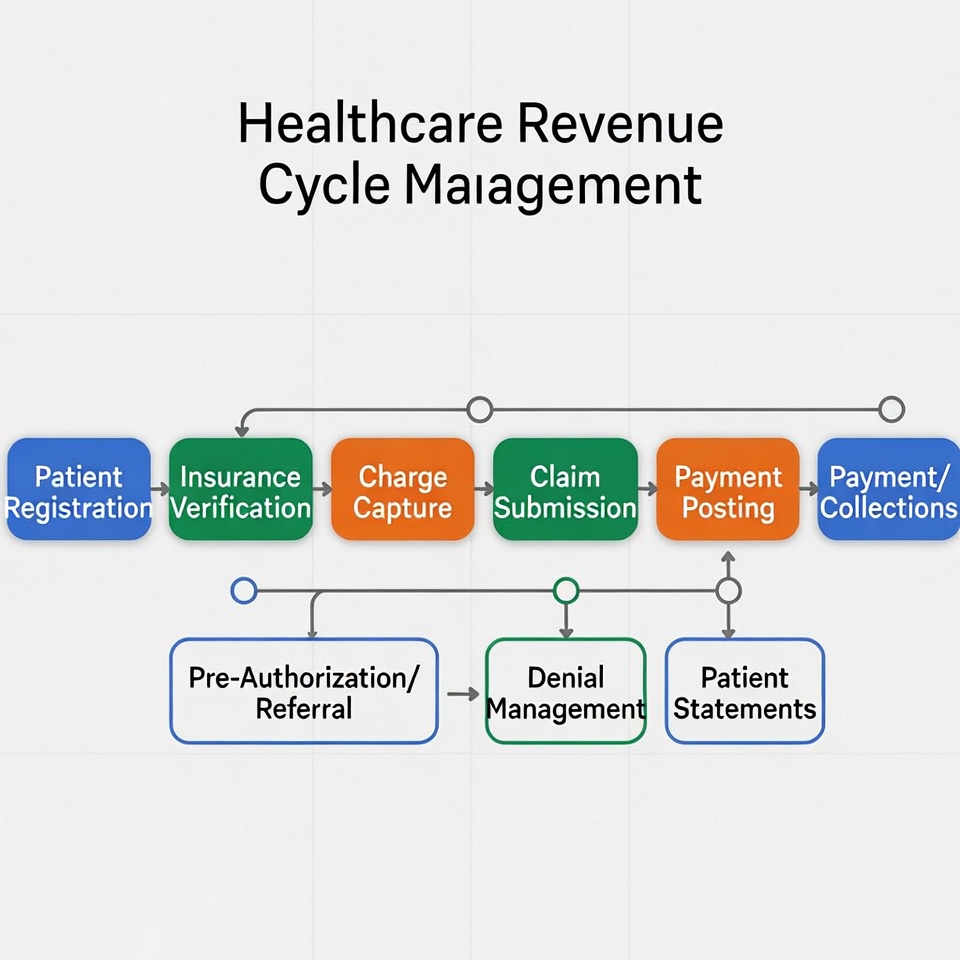
Revenue Cycle Management (RCM) is the complete financial process healthcare providers use to manage patient revenue; from the moment a patient books an appointment to the moment the final payment is collected. Across the United States, hospitals, private practices, and specialty clinics depend on strong Revenue Cycle Management systems to avoid lost revenue caused by billing errors, denied claims, and slow reimbursements.
How Revenue Cycle Management Works: A Simple Step-by-Step Process
A common question beginners ask is, “How does Revenue Cycle Management actually work in real life?” Let’s break it down in an easy, practical way.
1. Patient Registration & Insurance Verification
The RCM process starts as soon as a patient schedules an appointment. Accurate patient details and real-time insurance eligibility checks help prevent claim denials later.
2. Medical Coding & Charge Entry
After the patient receives care, diagnoses and procedures are converted into ICD-10, CPT, and HCPCS codes. Correct coding is extremely important, small errors here can lead to denied or delayed payments.
3. Claims Submission to Insurance Companies
Claims are then submitted electronically to Medicare, Medicaid, or private insurance companies. Most modern RCM systems use claim scrubbing to catch errors before claims are sent.
4. Payment Posting & Reconciliation
Once the insurance company processes the claim, payments are posted to the patient’s account. Any underpayments or missing payments are quickly identified.
5. Denial Management & Appeals
If a claim is denied, it is reviewed, corrected, and resubmitted. Effective denial management helps recover revenue that might otherwise be lost.
6. Patient Billing & Collections
Any remaining patient balance is billed clearly and professionally, improving collections while maintaining a positive patient experience.

6. Patient Billing & Collections
Any remaining patient balance is billed clearly and professionally, improving collections while maintaining a positive patient experience.
Why Revenue Cycle Management Is So Important for Healthcare Providers
Healthcare billing has become more complex every year. Insurance rules change often, payer requirements are stricter, and patients expect clear and accurate bills. This is why Revenue Cycle Management plays such a critical role.
A well-managed RCM process helps healthcare providers:
- Reduce claim denials and rejections
- Improve cash flow and faster reimbursements
- Lower days in accounts receivable (A/R)
- Maintain billing and coding compliance
- Gain better financial visibility
Simply put, RCM protects your revenue while allowing you to focus more on patient care.
Key Benefits of Revenue Cycle Management Services
Healthcare providers that use professional RCM services often notice real improvements in a short time.
Higher Revenue Collection
Accurate coding, timely claim submissions, and consistent follow-ups help capture revenue that is often missed.
Lower Operational Costs
RCM services reduce the need for large in-house billing teams, saving on staffing, training, and office overhead.
Faster Insurance Payments
Clean claims and automated workflows help reduce payment delays from insurance companies.
Compliance and Risk Reduction
Experienced RCM professionals stay updated on HIPAA, Medicare rules, CPT, and ICD-10 changes, helping reduce compliance risks.
Better Patient Billing Experience
Clear statements and quicker issue resolution improve patient trust and satisfaction.
Who Should Use Revenue Cycle Management Services?
Revenue Cycle Management is helpful for almost every type of healthcare provider, including:
- Hospitals and health systems
- Private medical practices
- Dental and orthodontic clinics
- Mental health and behavioral health providers
- Urgent care centers
- Physical therapy and rehabilitation clinics
- Multi-specialty healthcare groups
Whether you’re a solo provider or a growing organization, RCM services help you scale while keeping revenue under control.
Revenue Cycle Management vs Traditional Medical Billing
Many people think medical billing and RCM are the same thing, but they’re not. Medical billing focuses mainly on sending claims. Revenue Cycle Management covers the entire financial journey of the patient.
| Feature | Revenue Cycle Management (RCM) | Traditional Medical Billing |
|---|---|---|
| Scope | Full revenue lifecycle | Claims submission only |
| Main Goal | Maximize and protect revenue | Process claims |
| Denial Handling | Proactive and ongoing | Mostly reactive |
| Reporting | KPIs and financial insights | Limited visibility |
| Scalability | Easy to scale | Limited flexibility |
RCM takes a long-term, strategic approach instead of handling billing tasks one by one.
Conclusion: Why Revenue Cycle Management Matters in 2025
As healthcare continues to evolve, billing and reimbursement are becoming more complex. Revenue Cycle Management is no longer optional, it’s essential. With the right RCM process or partner like CureIntent, healthcare providers can improve collections, reduce denials, stay compliant, and focus more on patient care.
For official guidance on billing and reimbursement standards in the USA, providers can refer to the Centers for Medicare & Medicaid Services (CMS).
FAQs
What does Revenue Cycle Management include?
RCM includes patient registration, insurance verification, coding, billing, claims management, denial management, payment posting, and patient collections.
How much do RCM services cost in the USA?
RCM includes patient registration, insurance verification, coding, billing, claims management, denial management, payment posting, and patient collections.
Is Revenue Cycle Management HIPAA compliant?
Yes. Trusted RCM providers follow strict HIPAA guidelines and use secure systems to protect patient data.
Can small medical practices benefit from RCM?
Absolutely. Small practices often see the biggest improvements in cash flow and administrative efficiency.
Should RCM be outsourced or handled in-house?
Many healthcare providers outsource RCM to reduce costs, gain expertise, and improve financial performance.